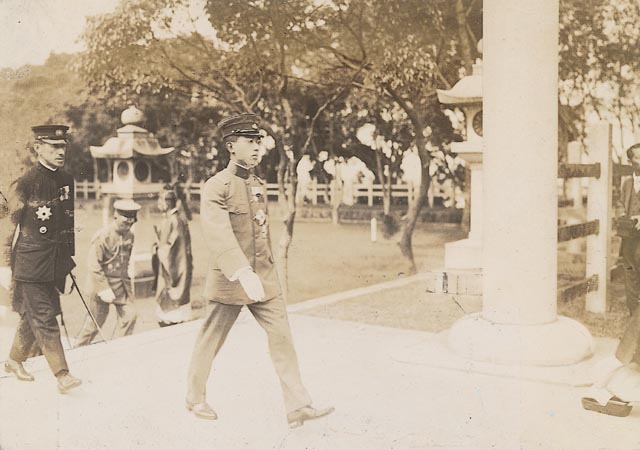
This week: Taiwan was the first overseas territory annexed by Japan with a large existing population. So how did the government’s policies on religion–and especially Shinto–help shape the nature of Japanese colonial rule there? And how did those policies evolve as Taiwan’s own place in the empire changed?
Sources
Shimizu, Karli. Overseas Shinto Shrines: Religion, Secularity and the Japanese Empire
Nakajima, Michio. “Shinto Dieties that Crossed the Sea: Japan’s ‘Overseas’ Shrines’, 1868 to 1945.” Japanese Journal of Religious Studies 37, No 1 (2010)
A Taipei Times article on the Xilai Temple Incident and its role in Taiwanese history.
Images

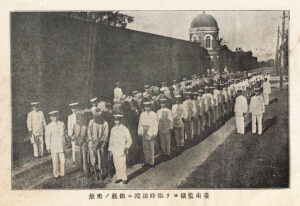
I wanted to make a few comments, I generally enjoyed the podcast but I wanted to highlight some linguistic details that may have been overlooked. My background is Taiwanese and I wanted to add a little more detail to some elements of the podcast that stuck out to me.
In general, I would have liked it if you delved a little more into the linguistic complexity of Taiwan and I feel like there was quite a lot of “Mandarin-Washing” in this episode. Mandarin was not widely spoken on Taiwan until the Nationalists took over so from an historical context, I found it a little jarring to hear so many Mandarin phrases when discussing a period of time when Mandarin was not used. You used the ambiguous term “Chinese” when referring to the languages spoken by the Taiwanese but I highly doubt Mandarin was used. “Chinese” when used to name a language, is more of a linguistic family than a specific language. The common language at the time is referred to as “Taiwanese” which is a dialect of Minnan, a sinitic language from the southern coast of Fujian. Mandarin, as we currently know it (although Mandarin itself is a linguistic sub-family), is based entirely on the dialect from Beijing and wasn’t implemented as the official language of the Republic of China until the 20s.
I have to say, although your use of Mandarin is particularly impressive, I feel like a part of my own personal culture gets Mandarin-washed whenever people generally talk about Taiwan. The Nationalists did an effective job of putting down Taiwanese (the language) as a vulgar languagae in comparison to the “cosmopolitan, useful, and modern” Mandarin.
Referring to the city Taipei, you insisted on pronouncing it “Taibei” based on Pinyin romanization rather than “Taipei” which is based on Wade-Giles or the Japanese “Taihoku”. During the Japanese colonial era, most of the settler population of Taiwan would call it “Tai-pak”. What I am trying to say is that I don’t believe there is a correct way to say Taipei in English. From my understanding and my own experience, many Taiwanese people are used to Wade-Giles for the romanization of their cities in English despite the fact that pinyin sounds closer to the pronunciation.
There is a deep rabbit hole one can jump into when it comes to Taiwan and I understand that your podcast focuses on Japan and not Taiwan. However, I do think we should take a little more care to understand the intricacies of language and culture to better understand both areas. The Japanese colonial era on Taiwan is a complex subject with a profound effect on our world today. The actions of the KMT dictatorship on Taiwan in the aftermath of WW2 and how the Chinese Civil War dictates the relationship between the PRC and ROC today, intermingled with the attitude of local Taiwanese Hoklo (Fujianese), Hakka, KMT Refugee and aboriginal populations have all been deeply affected by Japanese actions.
I believe that clear cut Mandarin-washing without acknowledging the linguistic diversity of Taiwan (and China itself) takes away from the history of the island and its people and plays into KMT and CCP narratives about the status of Taiwan and the Taiwanese people.