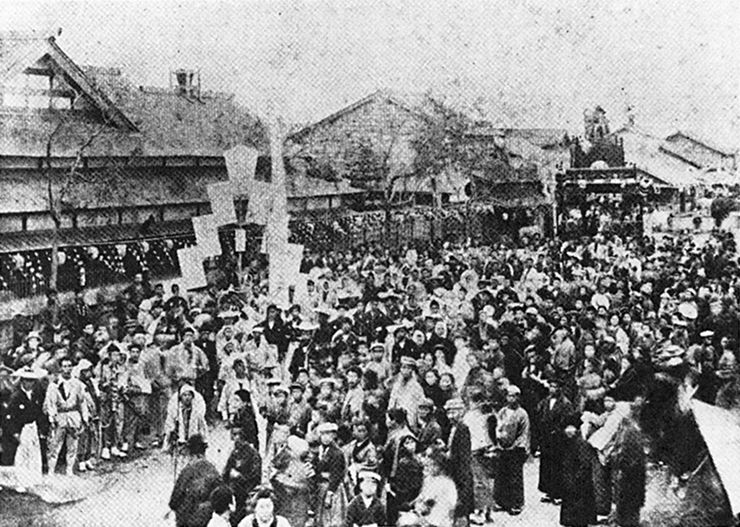
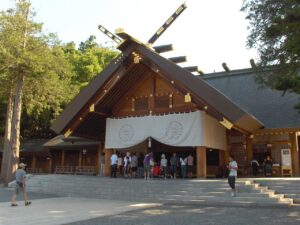
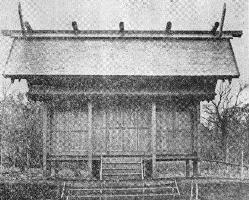
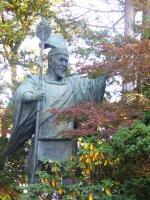
This week: how does the history of Shinto intersect with the colonization of Hokkaido? What role does Shinto’s transition from religion to “cultural institution” play in the process that has made that island indisputably a part of Japan itself?
Sources
Shimizu, Karli. Overseas Shinto Shrines: Religion, Secularity and the Japanese Empire
Rots, Aike P. “Public Shrine Forests? Shinto, Immanence, and Discursive Secularization.” Japan Review, no. 30 (2017)
A fascinating essay on Shima Yoshitake and historical memory by Michael Roellinghoff of Tokyo College.
Images

There’s something wrong with the rss
Hi Isaac and Demetria,
My name is Tadeas, I am almost 19. I’ve been an avid listener of history of Japan podcast for like a year now and out of all the podcasts i’ve listened to, yours is for sure my favourite. Japanese culture has always been close to my heart and your work has only pushed my interest further, which is why i have a really selfish request. I was wondering whether it would be in your competence to make (in a more narrow sense) an episode about the artists of the end of meiji period, or rather the start of the 20th century much like Toshi Yoshida and/or Kawase Hasui, both of whom have traveled the world and have documented various places throught-out the Earth through their eyes (this is really close to me as i’ve been an artist for 13 years and have been in love with their art.). There was also ( in the broader sense) the idea of making an episode concerning the society of japan and more specifically, the emigrating population from japan, during the first half of the 20th century, and the influence of japanese throught-out the world as a consequence of said emigration. To be honest with you mr. Meyer i have no idea whether you’ve made a video about this topic, but i thought it would be an interesting idea for episode. I am also deeply sorry before-hand as i still haven’t heard all your episodes as i’ve already said in the last sentence.
Anyway, i hope my comment reaches you and i would once again like to thank you both for the work you’ve done and your way of gathering information for your podcasts as well as your addictive and inspiring way of speaking.
Thank you, and sending my love to you from Slovakia
Sincerely,
Tadeas