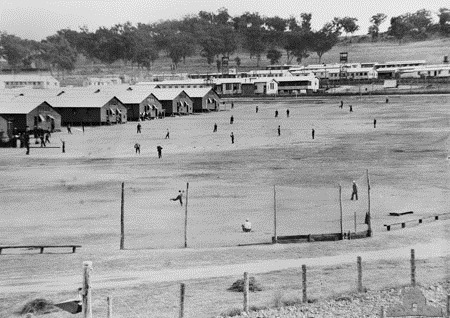
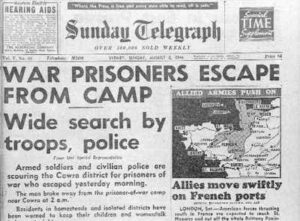
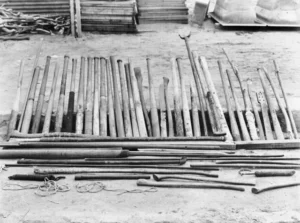
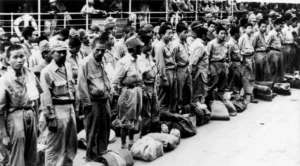
This week: the Cowra breakout seemed, to those who lived through it, like it came out of nowhere. But nothing does, so what factors led to it? How did the breakout itself play out? And what are its legacies, both in terms of Australia-Japan relations and the wider question of Japanese “fanaticism” in WWII?
Sources
Australian War Memorial Oral History Recording S03331,TITLE: Marekuni Takahara, Masayoshi Yamada and Teruo Muakami as former Prisoners of War NO 12 Camp Cowra 1944 -1945
Starr, Alison. “Forever Alongside: War Cemeteries as Sites of Enemy Reconciliation.” Asia Pacific Journal, Japan Focus 20, No 3 (2022)
Australian Government Dept of Veteran’s Affairs ANZAC Portal page on Cowra
Images
I love the way you describe Australia as “an island” as though it were the size if Ellis Island and not the continental US 🤣
Growing up in Australia in the 70s, when many WWII veterans were in their 50s and 60s, I often heard the “emperor worship” trope used as a rationalisation for the treatment of Australian POWs. Which is to say, because “dying for the emperor” made being captured disgraceful, Australian and Allied POWs were not seen as “deserving” humane treatment as prisoners. I think this trope developed as a way to explain levels of brutality that most people had trouble coming to terms with.
Love your podcast! I’ve been listening weekly for an a very long time, from the very eqrly episodes. it’s refreshing to hear the history of my country through a different perspective.
I have an episode request. My uncle was a POW during and after WWII in Siberia. I remember a family lore that he didn’t return home until a few years after the end of war. I would love to have you do an episode about it!